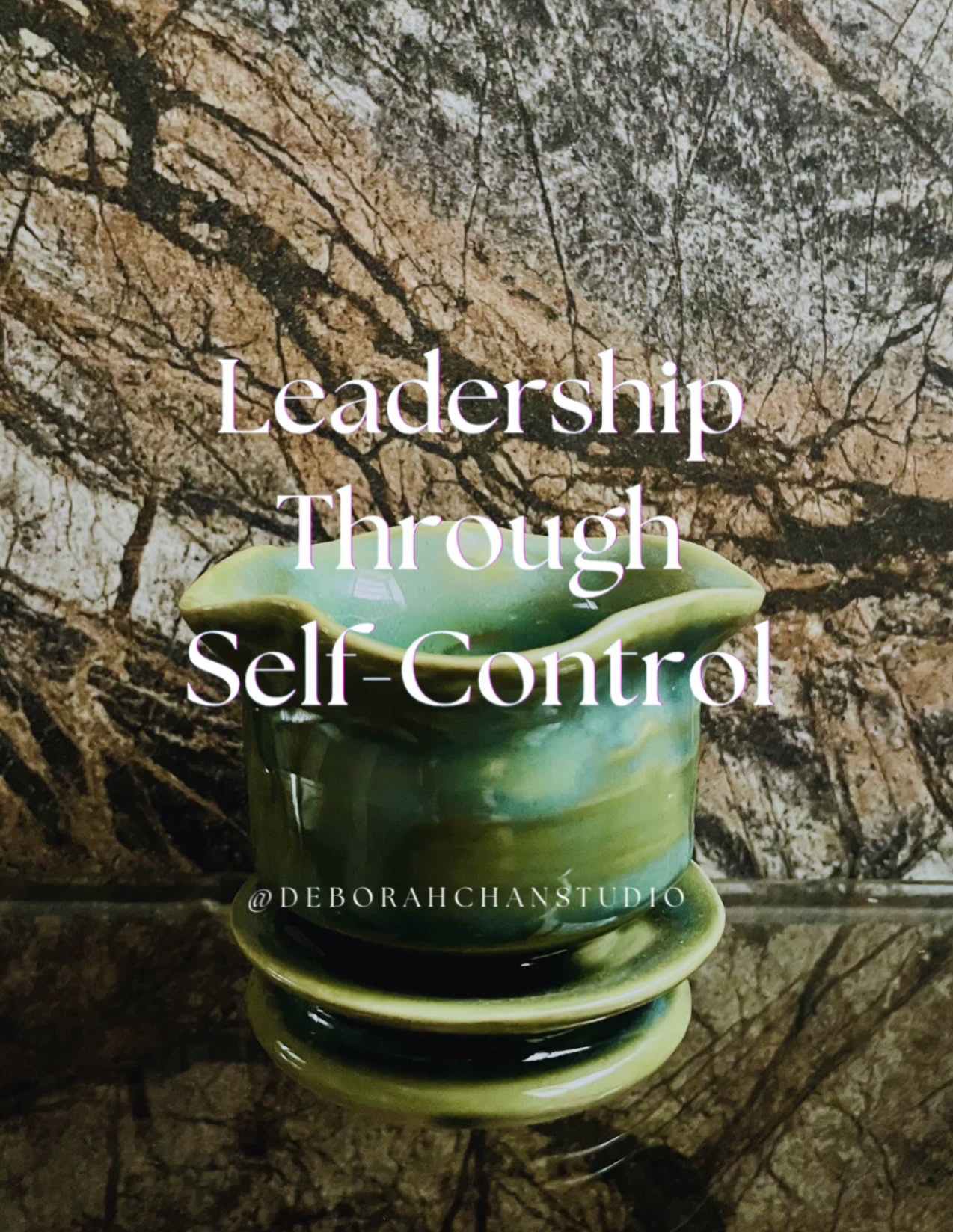
By Deborah Chan | 10.6.26
The Potter's Discipline: Leadership Through Self-Control.
Leadership Begins with Self-Control
Many leaders fall into a subtle trap: believing their role is to control outcomes and shape every person around them into a predetermined vision. They become consumed with managing every detail, directing every action, and ensuring that everyone conforms to a particular mold. Yet the strongest leaders understand a different truth. Leadership is not primarily about controlling others. It is about controlling oneself. The art of pottery offers a powerful lesson. The potter’s greatest discipline is not control over the clay. It is control over their own hands. Every movement must be measured. Every adjustment must be intentional. The potter must resist the urge to force results before the clay is ready. Patience becomes as important as technique. Restraint becomes as valuable as strength.
People Are Unique, Not Meant for One Mold
People are not lumps of clay waiting to become identical copies of one another. Each individual brings unique experiences, gifts, perspectives, ambitions, and ways of contributing. When leaders attempt to force everyone into the same mold, they often achieve compliance at the expense of creativity, trust, and growth. The goal of leadership is not uniformity. The goal is development. Just as a potter works with the natural qualities of the clay, leaders work with the unique qualities of people. Some individuals need encouragement. Others need challenge. Some flourish with autonomy. Others grow through mentorship. Great leaders recognize these differences and adapt rather than impose.
Patience and Restraint Are Essential Leadership Skills
This requires tremendous self-control. It means resisting the urge to micromanage when anxiety rises. It means choosing patience when progress feels slower than expected. It means maintaining composure when outcomes are uncertain. It means leading through influence rather than force. Many leaders become frustrated because they focus on controlling what ultimately lies outside their control. They obsess over outcomes, reactions, and timelines. Yet the most enduring results rarely come from manipulation. They come from consistent investment. A potter cannot pull a finished vessel from the wheel before its time. They trust the process. They trust the work they have put into the clay. They trust that careful shaping, proper firing, and patient attention will produce something worthwhile.
Influence Creates Growth Better Than Control
Likewise, effective leaders trust that their efforts are not wasted. Every conversation that builds confidence matters. Every act of integrity matters. Every moment of coaching, teaching, listening, and encouraging matters. The harvest may not appear immediately, but leadership is rarely measured by instant results. It is measured by the long-term impact left in people and organizations. The leader who continually invests in others without attempting to dominate them creates conditions where growth naturally occurs. The irony is that the more a leader tries to control people, the less influence they often possess. People resist being molded against their will. They withdraw their creativity, their initiative, and their ownership.
Self-Mastery Builds Trust and Long-Term Impact
But when leaders exercise self-control instead, controlling their reactions, their ego, their impatience, and their need for certainty, they create space for others to become their best selves. The finest pottery is not the result of force. It is the result of skilled hands guided by patience, discipline, and respect for the material being shaped. The finest leadership follows the same principle. A leader’s greatest power is not the ability to control people. It is the ability to control themselves. From that self-mastery comes wisdom. From that wisdom comes trust. And from that trust comes the kind of growth that no amount of force could ever achieve. Like the potter at the wheel, leaders must focus less on controlling the clay and more on mastering their own hands. The vessel will take shape in time.
A leader's greatest power is not the ability to control others, but the ability to control themselves. Like a skilled potter, effective leaders shape growth through patience, discipline, and respect for the unique qualities of the people they lead.
Disclaimer: This content was created with the assistance of artificial intelligence. All concepts, ideas, and themes are solely owned and originated by the author. The AI tool was used solely as a writing aid and does not claim ownership of the concepts or creative direction.